
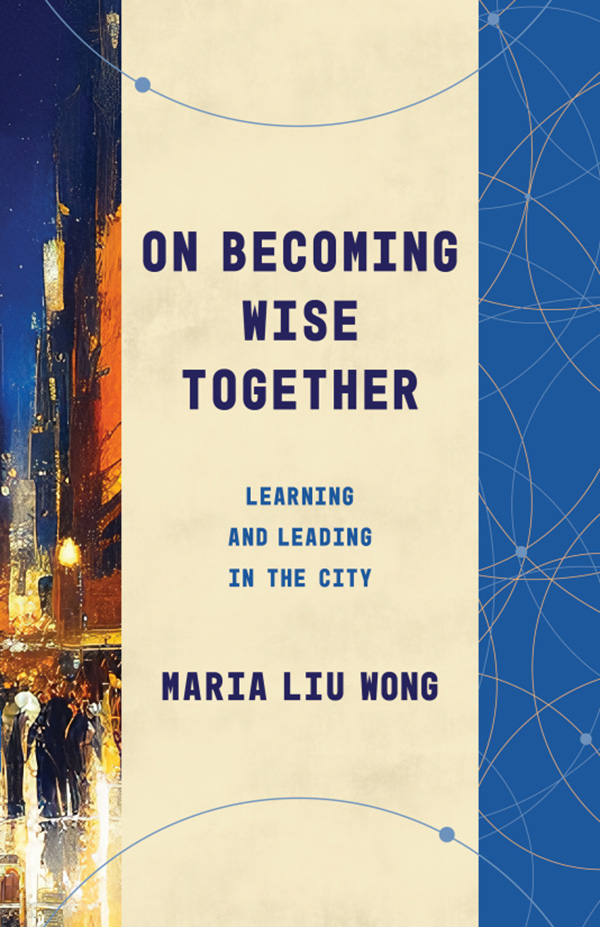
‘On Becoming Wise Together: Learning and Leading in the City’
This book reframes traditional Euro-North American conceptions of theological education by reflecting critically on my lived experience as a British-born Chinese-North American woman, a family member, an immigrant, an urban theological educator, a maker, a gallery curator, a community gardener, a Girl Scout troop leader, and a scholar. It is not limited to the context of formal institutions recognized as places where theological education happens, nor the content of a seminary curriculum as philosopher and theologian Friedrich Schleiermacher might have designed it in nineteenth-century Germany. It reimagines theological formation for the many together rather than the individual alone, and as happening in a wide range of times, spaces, and places.
I propose here that intercultural and communal understandings of theological teaching and learning suit the context of a complex and quickly changing urban world better than individualistic, rational Western habits of knowing. We are in the midst of a moment in which the reemergence of a model of collective wisdom is challenging the expert-knowledge approach that is bolstered by an information economy and capitalism. Traditional forms of theological education built out of a particular cultural and historical paradigm to educate individual, and usually male, ordained clergy are no longer relevant, accessible, nor sustainable; this is evidenced by multiple national studies on the decline of the North American church, diminishing student numbers, and increasing financial instability of theological institutions. The entire ecosystem of theological education is grappling with the need to reexamine systems and structures and innovate new “pathways to tomorrow.”
Now, how and where we come to know and with whom we come to know are as important as what we know. We are learning again how to learn. Rather than receiving inherited knowledge, we are expanding sources and means of understanding and being; we are living theology as a verb.
This collaborative approach to cultivating wisdom has some resonance with the early church. In Acts 1:12-14, when the apostles and others were sent back to Jerusalem to await direction after Christ’s return to heaven, they gathered together, prayed, and waited. The Pentecost was a spiritual and physically embodied event that included the sound “of a violent wind” that came from heaven and “tongues of fire” that came to rest on each of them. The filling of the Holy Spirit led to the powerful testimony of Christ’s reality and good news, in every language of those present.
From there, a crucial decision was made in Acts 15 after much discussion and discernment through the Holy Spirit, namely, that the church need not be culturally homogeneous. Rather, the church was for the Jew and the gentile. It was together that the church waited in order to become wise.
In our own contemporary time of uncertainty and unraveling, we too are waiting, waiting for the wisdom needed for this turbulent age. We as a world Christian church can come together around what Latina theologian Elizabeth Conde-Frazier calls la mesa. This is not simply to redistribute power and resources from a historical center to the margins (presuming there even is a legitimate center) and to confront a legacy of structural and systemic racism in institutions and communities. It is an opportunity to witness a rearrangement of locations, a remapping of plural centers of power and margins of possibility.
The late African American writer bell hooks describes the margin as “a profound edge. Locating oneself there is difficult yet necessary. It is not a ‘safe’ place. One is always at risk. One needs a community of resistance.” By embracing the tension of writing out of the margin, from who and where I am, this work performs an alternative, aesthetic, oppositional act of becoming, of creating space to see differently and make meaning. It is a book I write to remember, to rehearse, and to map out what God has done in places where I come from, where I have been, and where I am going with others, with my “community of resistance.” This is not simply nostalgia, as bell hooks points out; it is a “remembering that serves to illuminate and transform the present.” I take time to pause, reflect, and connect the dots of seemingly disparate stories that show how God is at work in my life.
In listening to and sharing stories of coming together around la mesa, we encounter the possibility to engage a complexity of kinds of knowledge and approaches to wisdom. Through such coming together as the diverse but unified body of Christ, we can enter a liminal space between what is familiar and what is unknown. This is true for theological education as it has been described, and for our world more broadly, in these times between the times.
The late Scottish missiologist Andrew F. Walls suggests that through such necessary coming together we are returning to an “Ephesian moment” in our day, a moment in which our global urban world reflects an even greater diversity than in the early days of the church of what it means to be “Christian.” The reality is that we need each other now more than ever. “The very height of Christ’s full stature is reached only by the coming together of the different cultural entities into the body of Christ. Only ‘together,’ not on our own, can we reach his full stature,” notes Walls. This reimagining and reorientation take the form of the church flourishing in its diversity and becoming God’s shalom together in the city as family, friends, learners, and leaders. God’s shalom is found in the reconciling of God’s creation to right relationships with God, self, the other, and the natural and spiritual realms.
If, as Walls suggests, “the purpose of theology is to make or clarify Christian choices,” and if this attempt to think in a Christian way comes from within particular contexts and cultures, and in interaction with the Bible, then we are asking new questions every day. We are converting the material of life toward Christ through this Spirit-informed creative process that involves thinking, feeling, and acting. Yet will the church in all its diversity “demonstrate its unity by the interactive participation of all its culture-specific segments, the interactive participation that is to be expected in a functioning body? … Will the body of Christ be realized or fractured in this new Ephesian moment?”
As it did in the early days of Acts when practices of radical hospitality challenged the intersectionally compounded boundaries of class, gender, law, and tradition, so today the physical and spiritual realization of the body of Christ has theological, social, and economic consequences. The implications are ever present in intensified moments of pandemic, protest, increased racism and violence, globalization, and climate change. The invitation is to embrace being a part of Christ’s body while moving with others toward completion. In this movement, we need the generative work of the Holy Spirit to take action in us.
Excerpted from “On Becoming Wise Together: Learning and Leading in the City,” by Maria Liu Wong ©2023 (Wm. B. Eerdmans Publishing Co.). Reprinted by permission of the publisher.
The entire ecosystem of theological education is grappling with the need to reexamine systems and structures and innovate new ‘pathways to tomorrow.’